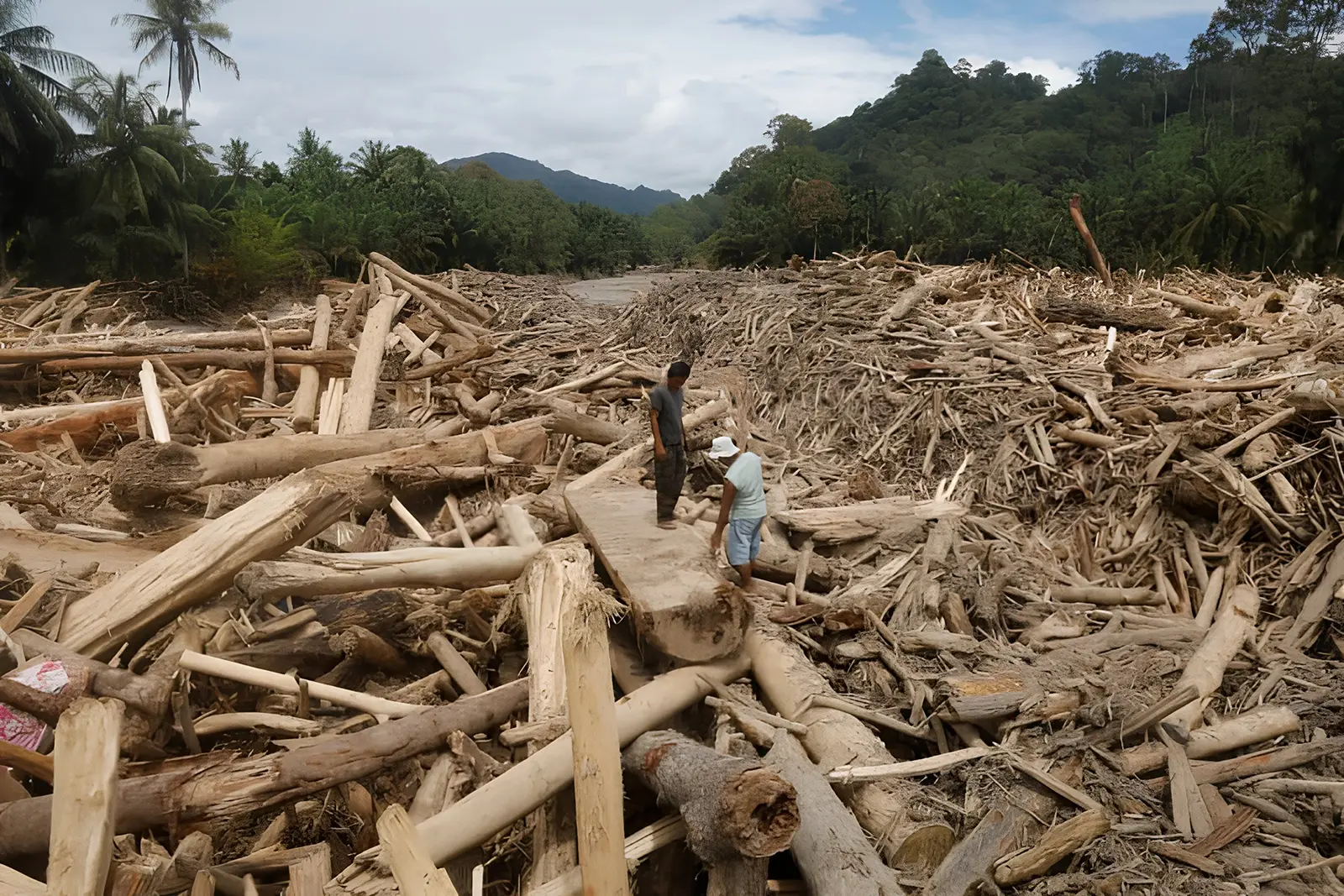
Men stand on logs swept away by flash flood in Batang Toru, North Sumatra, Indonesia, Tuesday, Dec. 2, 2025. Photo credit: AP Photo/Binsar Bakkara
If you followed the coverage of the devastating floods in Sumatra in late 2025, you might’ve noticed something unusual: this time, deforestation wasn’t a footnote — it became part of the headlines.
Images of thousands of cut logs being swept downstream, smashing through homes and bridges like battering rams, were broadcast across Indonesia and beyond. Those scenes have become impossible to ignore, and they’ve forced a truth into the public conversation that locals have known for decades:
These floods were not just caused by heavy rain.
They were supercharged by the way the land has been stripped bare.
How Deforestation Turned Heavy Rain Into a Catastrophe
While extreme weather and climate change certainly intensified these storms, rainfall alone doesn’t explain the severity of the destruction. The system that triggered the downpours — Cyclone Senyar, a highly unusual tropical cyclone forming so close to the equator — brought rainfall that could have caused flooding even in intact, healthy landscapes. But the scale and violence of what happened were not inevitable.
Sumatra has always had monsoon seasons and periodic storms. What it hasn’t always had is climate change-driven cyclones combined with millions of hectares of missing forest.
When forest is intact, the land behaves like a giant sponge:
- tree roots hold soil together
- leaf litter absorbs and slows water
- dense canopies break the fall of rain
- the ground releases water gradually instead of all at once
When that system is stripped away, the landscape loses its ability to soak up and slow down rainfall. Bare soil repels water instead of absorbing it, accelerating flash floods, landslides, and debris flows (fast-moving rivers of water, soil, rocks, and vegetation — including heavy cut logs — that rush downhill during heavy rain, causing massive destruction).
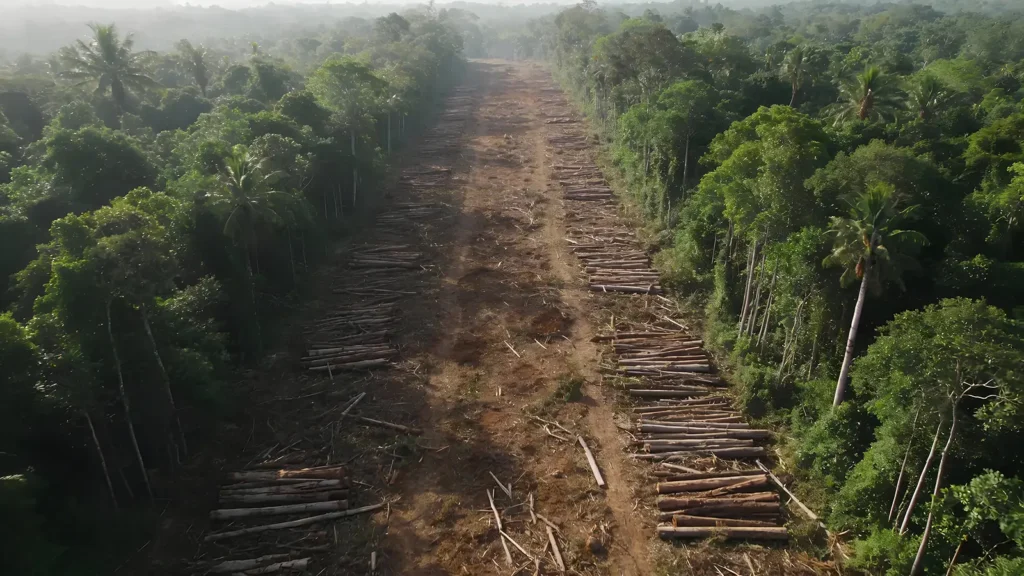
In Sumatra, the forest hasn’t just been thinned. It has been carved up, cleared, and converted at a staggering scale.
Over the last few decades, vast swathes of Sumatra’s rainforest have been lost. In 2024 alone, Sumatra reportedly lost 91,248 hectares of forest, the second‑highest deforestation rate of any island in Indonesia that year. Indonesia’s total forest loss in 2024 was over 240,000 hectares, according to analysis by The TreeMap’s Nusantara Atlas project.Once that natural protection is gone, the land just can’t cope with rainfall the way it used to.
The link between deforestation and flooding in Sumatra isn’t guesswork — it’s rock-solid. Studies from the Center for International Forestry Research (CIFOR), Bogor Agricultural University (IPB), and Wetlands International, to name just a few, show exactly how clearing forests and draining peatlands turns heavy rain into flash floods, landslides, and debris flows.
Decades of research confirms it: intact forests slow runoff, stabilize soil, and keep rivers in check. Remove them, and rainfall hits bare earth, surging downhill with destructive force. The floods in late 2025 weren’t just extreme weather — they were a predictable consequence of stripped landscapes.
So What’s Driving This Deforestation?
Deforestation in Sumatra is driven by a mix of industries and land-use pressures, but four main factors dominate:
- Oil Palm Plantations
The largest driver of forest loss. According to CIFOR, between 2001 and 2019, Indonesia’s oil palm plantations doubled from 8 million to 16.24 million hectares — that’s over two-and-a-half times the size of Tasmania. - Industrial Timber Plantations (Pulp, Paper, and Furniture)
Industrial timber plantations — including those for furniture — replace forests with monocultures that destroy habitats and create landscapes that can’t hold water or stabilize soil. - Logging (Legal and Illegal)
Selective logging weakens forests, reducing canopy cover, disrupting roots, and compacting soil. Both legal and illegal logging degrade the natural flood buffer, and demand for furniture made from plantation timber contributes to this. - Smallholder Expansion
Agricultural clearing on hillsides without terracing accelerates water runoff and soil erosion, compounding downstream flooding.
Together, these drivers explain why Sumatra’s forests no longer act as natural flood defenses. The common thread: loss of trees that once held together soil, absorbed rain, and slowed water flow.
Where Does Furniture Wood Fit In?
We’ll be the first to admit that there is no official statistic isolating how much deforestation in Sumatra is caused specifically by plantation tree species grown for furniture.
What researchers can measure is how much forest was cleared and later converted into plantations overall, and we know the biggest culprits are oil palm and pulp and paper.
So, while we can’t put an actual figure on it, legal and illegal logging for furniture is absolutely still part of the problem.
Both legal and illegal logging contribute to ongoing forest degradation, and degraded forest is significantly more prone to flooding.
Just because furniture isn’t the biggest driver does not mean it is guilt-free.
Why This Matters for Anyone Who Buys Wooden Furniture
Conversations like these often end with looking elsewhere, as if consumers have no role to play.
But if people genuinely want to reduce the chance of seeing Sumatra’s floods, landslides, and log-clogged rivers repeat themselves year after year, the starting point is simple:
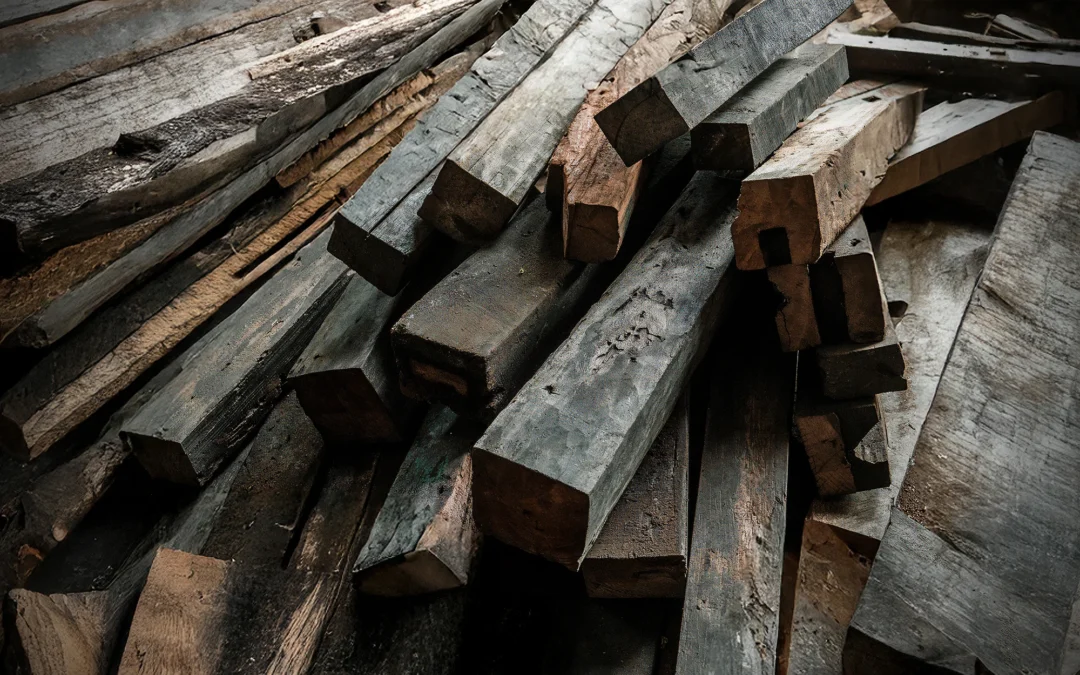
Stop increasing demand for newly harvested wood by choosing reclaimed wood instead.
Reclaimed wood doesn’t require a single new tree to be cut down. It doesn’t fuel plantation expansion. It doesn’t encourage logging in degraded forests. And it doesn’t require land conversion from biodiverse ecosystems into monocultures.
In short: reclaimed wood furniture breaks the link between your home and someone else’s deforested landscape.

Where Nusantara Lifestyle Fits Into This Picture, In Our Own Small Way
Since the beginning, we’ve always operated from this principle:
Only use wood that already exists.
Our reclaimed teak comes from traditional homes and structures in Java — material that has already lived a long life, and now gets to live another.
We don’t rely on plantations.
We don’t contribute to land conversion.
We don’t feed demand for newly logged timber.
And now, with our FSC Recycled certification, that commitment is verified by the highest global standard for responsible forest products.
We know we’re just one small company, but change doesn’t begin on a massive scale. It begins with choices.
If you care about anything we’ve said above, take a look at our reclaimed teak Alami furniture, Akar flooring, decking and cladding, and Ndalem homewares, which have all been made without cutting down a single tree.