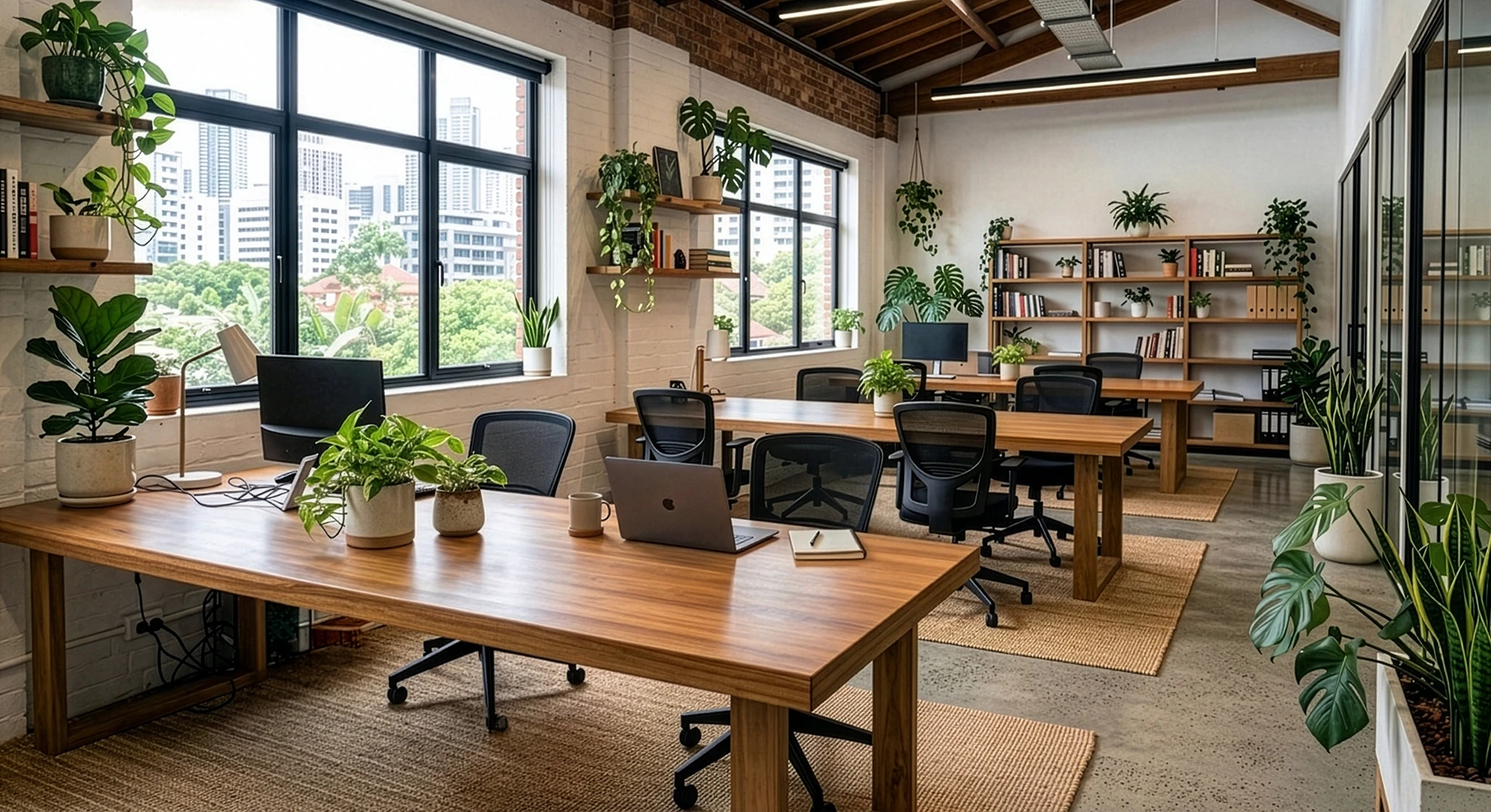
Designing a “green office” in Australia?
Before you tick those ESG boxes, chase a Green Star rating, or fill the space with indoor plants… let’s ask a simple question:
What are your desks made of?
Because here’s the sad reality: many “sustainable” offices are still fitted out with the same mass-produced furniture, engineered boards, and plantation timber dressed up with a certification and a nice tree-planting story.
Add a few energy-efficient lights and a recycling policy and suddenly it’s a “green workspace”.
Yeah… not quite.
If the materials aren’t legit from the start, we say the whole thing is built on shaky ground.
What makes an office truly sustainable in Australia?
A truly sustainable office in Australia starts with material choices, not just energy efficiency. Furniture made from reclaimed timber, such as reclaimed teak, reduces the need for new logging, lasts significantly longer, and lowers long-term environmental impact compared to plantation timber or engineered boards commonly used in office fitouts.
The Problem With “Sustainable” Office Furniture
It’s safe to say that most office furniture that’s marketed as sustainable in Australia is built from:
- Plantation timber
- MDF and engineered boards
- Veneers made to look like solid wood
We know, we know. This kind of stuff is quick to produce, easy to match to specifications, and simplifies the purchasing process. Take a few measurements, click, click, click, and it’s at your office door a week later.
But does it hold up over time? And does it genuinely reduce environmental impact?
Not really.
Plantation timber gets sold as the clean, renewable solution. But monoculture plantations — which require heavy water use and lots of chemicals, not to mention their long growth cycles and the fact they’ve wiped out biodiversity — paint a very different picture. It’s easy to see why plantation timber is not nearly as sustainable as the brochures make it out to be.
And engineered products? They rely on glues, thin layers, and processes that don’t exactly age well, especially under daily use.
So while everything looks good on paper, the real-world performance tells a very different story.
Sustainability Isn’t Just Energy and Certifications
In Australia, sustainable office conversations tend to focus on:
- Energy ratings
- Heating, Ventilation, and Air Conditioning (HVAC) efficiency
- Lighting systems
- Certifications and compliance
All important, no doubt. But here’s what gets overlooked:
The materials inside the space.
If your entire office fitout is built from short-life materials — desks and cabinetry made from MDF, for example — you’re locking in waste from the very beginning. Perhaps you’ve unknowingly fallen into the fast furniture trap?
No certification really fixes that.
FSC Certification: What It Means (And What It Doesn’t)
You’ll see a lot of furniture in Australia carrying Forest Stewardship Council (FSC) certification, either FSC 100% (all materials are from FSC certified forests) or FSC Mix (a combination of certified, recycled, or controlled materials).
Let’s be clear: FSC plays an important role. It sets standards for responsible forest management and helps ensure timber is sourced from forests that are managed with environmental and social considerations in mind.
Nusantara Lifestyle is FSC certified too — and we’re proud to have FSC Recycled certification, meaning all materials used are from reclaimed sources.
But here’s the nuance that often gets missed: Those FSC 100% and FSC Mix certifications still apply to new timber.
It doesn’t change the fact that trees are being harvested, processed, transported, and turned into products that may or may not last the distance in an office setting.
But reclaimed timber, which is the only wood we work with at Nusantara Lifestyle, sits in a different category altogether. What this means is our furniture, flooring, decking and cladding do not require biodiverse environments to be cleared, nor any new trees to be cut down, and certainly no use of energy-intensive kilns.
We only use timber that has already stood the test of time, and we’ve carefully salvaged it, restored it, and turned it into something that will last a hell of a lot longer than anything chucked together in a factory. (Take a look at this nifty little video we made exploring our entire salvaging process.)
So remember, while the FSC 100% and FSC Mix certifications are a step in the right direction, they’re not the full picture.
If you’re aiming for a genuinely low-impact office, it’s worth looking beyond certifications and asking a simpler question:
Are you using new material, or making better use of what already exists?
Why Reclaimed Teak Lasts the Distance
We’ll keep this brief:
Reclaimed teak has already been through decades of real-world conditions.
The timber we use has:
- Naturally dried over decades (sometimes even close to a century)
- Stabilised without being rushed through kiln processes
- Built up density and strength you just don’t get with new timber
That means:
- Minimal movement
- Strong resistance to cracking and warping
- Better performance across temperature and humidity changes
And most importantly… it lasts.
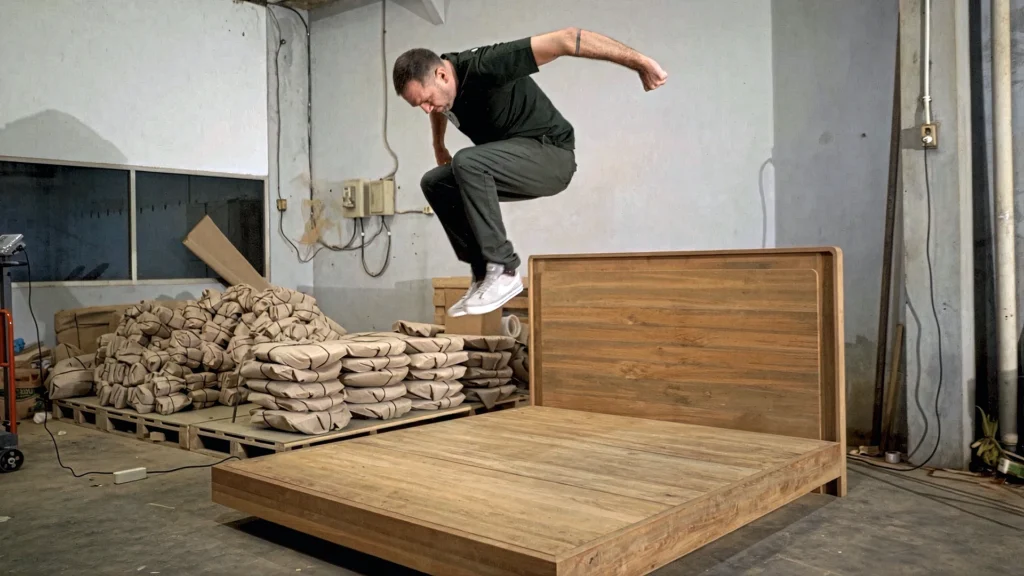
This isn’t furniture you replace every few years. It’s furniture that sticks around, which is kind of the whole point of sustainability. Still have questions? Here’s our co-founder Will giving a quick overview on the strengths of reclaimed teak.
It’s Not Just Desks
When people think office fitouts, they think desks and chairs.
But look closer:
- Boardroom tables
- Reception counters
- Joinery and cabinetry
- Shelving and storage
- Breakout areas
These are high-touch, high-use surfaces. If they’re made from low-quality materials, they show wear quickly — but not in a good way.
Reclaimed teak is entirely different. It ages beautifully. It grows in character instead of falling apart. There’s a big difference between “worn out” and “worn in”.
So… Is It Actually a Green Office?
Bit of a blunt one, but worth asking.
If your office is fitted out with:
- Plantation timber
- Engineered boards
- Short lifecycle furniture
Then the “green office” label might be doing some heavy lifting.
Start With the Materials. Always.
If you’re designing or upgrading an office in Australia, start here:
Where does your timber come from?
How long is it actually going to last?
What happens when it needs replacing?
Reclaimed teak answers those questions pretty clearly.
No, it’s not the easiest option.
But if you actually want a green office… it’s a bloody good place to start.
If you’re planning an office fitout and want to explore reclaimed teak desks, tables, or custom cabinetry, we’re always up for a chat.