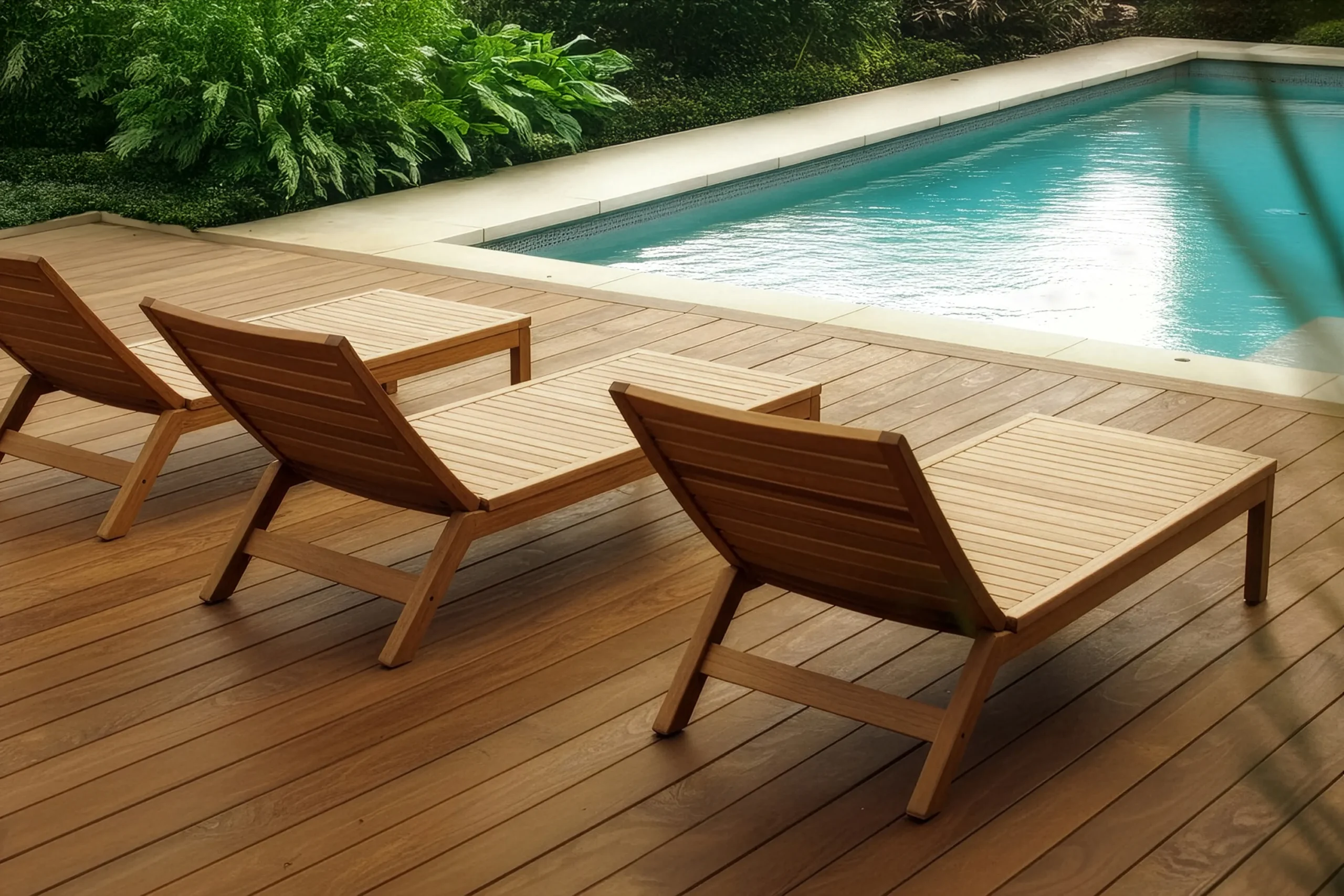
Thinking of building an “eco” resort?
Here’s the truth: it starts with the materials. Reclaimed timber for furniture, flooring, and almost every bit of wood your guests touch is the greenest option available. These are finishes that aren’t just for Instagram. Get your materials right, ask the tricky questions from Day 1, and you might just be able to back up the eco label instead of greenwashing your way through with marketing spin.
Here in Bali, and in pretty much all tourism-heavy economies, it seems every new accommodation project is slapping on the “eco” tag. And if it’s not, then “sustainability” or “green” or “environmentally responsible” feature heavily in the branding. But these buzzwords have become so common that most of the time they don’t mean 💩.
In reality, for many of these properties, “eco” just boils down to a styling choice, something added late in the process once the concrete’s been poured, the huge pool has been filled, and rooms have been fitted out with plantation teak furniture. Perhaps a bit of bamboo here, some indoor plants there. Maybe a few solar panels, signs asking guests to reuse their towels and bed linen, a sustainability page on the website. Job done.
But as we should all know by now, this isn’t sustainability. To be genuine, sustainability needs to be a core part of a project’s materials, systems, and operations from the very beginning. And when you look closely at how many self-proclaimed “eco resorts” there actually are here on the island and across the world, the gap between the label and the reality is often huge.
Because in places where development moves fast and government and regulatory oversight is lacking, like here in Bali, greenwashing can get completely out of control.
Sustainability Needs to Start Long Before Styling
So, if you’re serious about building an environmentally conscious property in Bali, or anywhere, whether that’s a boutique hotel, a jungle retreat, or a private villa, then timber use, flooring, and cement need to be part of your planning from Day 1.
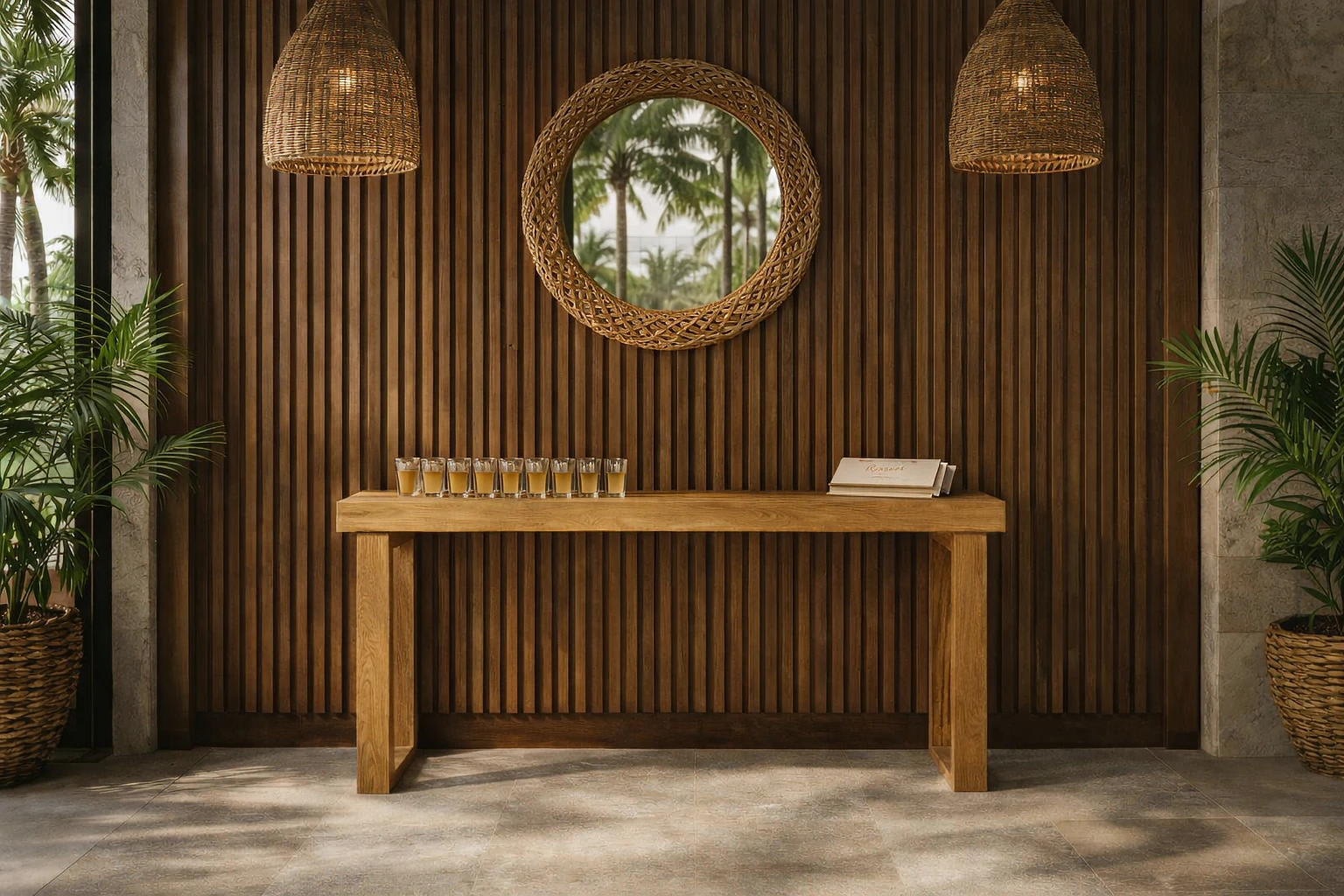
Furniture and Timber: Where Eco Claims Start Tumbling Down
Furniture, flooring, structural wood elements, and finishes… these are all things your guests will touch, sit on, walk across, and live with every day. What they’re made of and where they come from matters, so if you want your eco credentials to actually mean something, this is where you need to pay attention.
Mass-produced furniture dominates in hospitality because it’s fast and predictable. But it also struggles in tropical environments. Humidity, heat, salty air, and constant use expose weak joints, rushed kiln drying, and low-quality finishes very fast.
Why Reclaimed Timber is Different
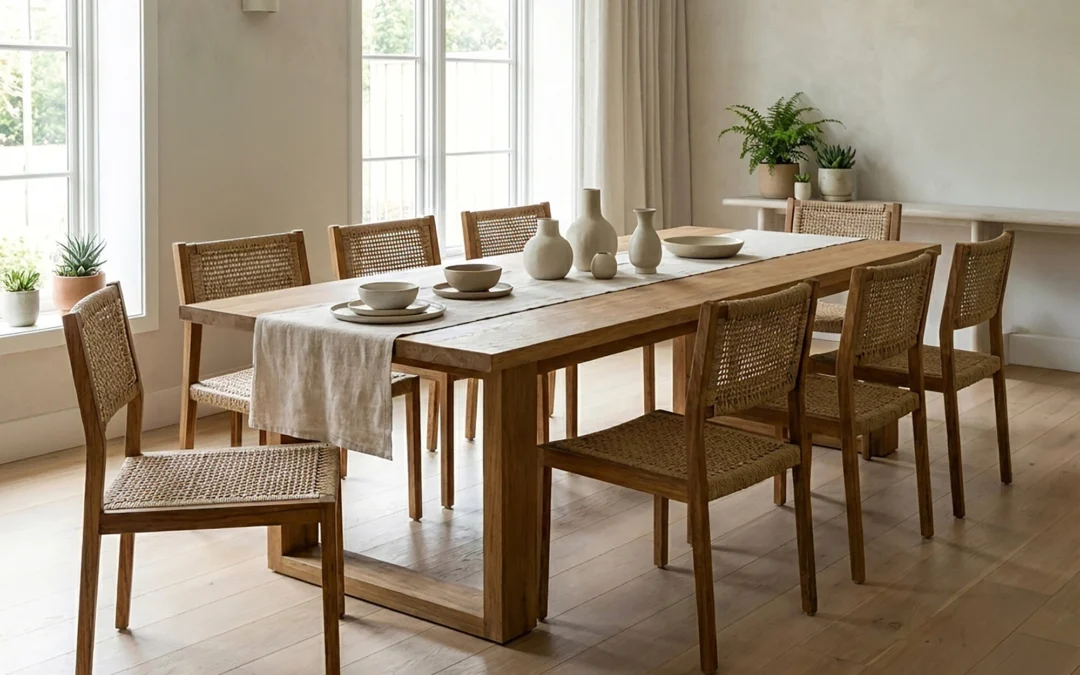
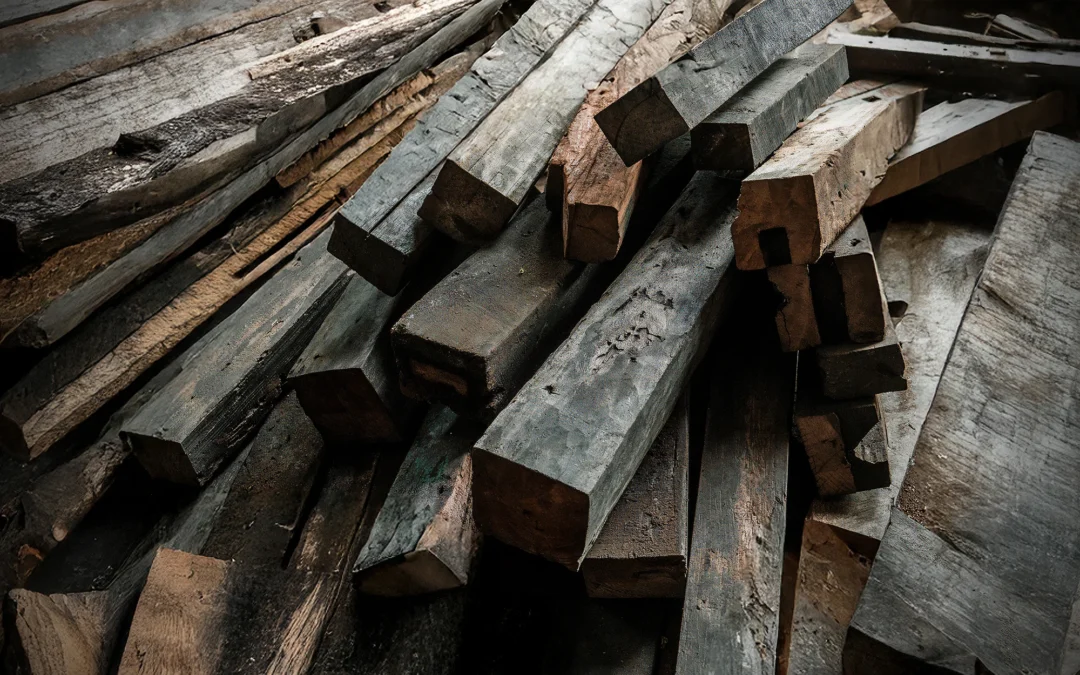
But custom furniture, flooring and finishes built from reclaimed timber lead to something very different. The reclaimed teak we use has already spent decades drying naturally in the elements, which makes it dense, stable, and far less prone to movement, cracking, or chipping.
This is what we mean by genuine sustainability — none of the wood we use has required new trees to be cut down, and what we make is built to last.
And it’s not just something we say. Nusantara Lifestyle is FSC Recycled certified, which means our reclaimed timber is independently verified under the Forest Stewardship Council system. That certification exists to ensure recycled timber is genuinely reclaimed and responsibly sourced, not just labelled that way for marketing.
Going with reclaimed is one of the simplest ways any project can back up its claims of being eco-friendly and actually walk the walk. Whacking on some solar panels or putting in a permaculture garden doesn’t mean much when a hotel’s entire furniture fitout has come from plantation timber.
Sustainability You Can Walk On
Flooring is another area where sustainability often falls down.
Thin engineered boards, veneers, and composite products are common in resort builds. They’re lighter, cheaper to install, and easier to source quickly. They also rely heavily on adhesives and layered materials and tend to have short lifespans.
It’s true, and we never try to sugar coat this: solid reclaimed timber flooring takes a lot more effort. It’s heavier and requires more work to install. But it lasts. It also handles moisture better, and when it wears, it looks better, not worse.
If an eco resort is serious about durability, flooring is not the place to cut corners.
The Material Everyone Ignores: Cement
There’s another material that rarely gets questioned in eco resort planning, even though we’re pretty sure it dominates almost every build in Bali: cement.
Concrete is everywhere. Foundations, villas, pools, retaining walls, pathways. It’s treated as unavoidable, which is why we reckon it often escapes scrutiny.
But cement production is extremely energy intensive and environmentally destructive. It relies on large-scale extraction, high-temperature processing, and chemical reactions that release huge amounts of carbon in the process.
According to the World Economic Forum, global cement manufacturing accounts for around 8% of total global CO₂ emissions, roughly 1.6 billion metric tonnes in 2022 alone, with that figure set to rise as demand continues.
Does the impact of cement use disappear because a resort uses refillable bathroom amenities? Nnnnope.
This doesn’t mean concrete can never be used. In some cases, such as pools, it is necessary. But pretending it has no environmental cost is greenwashing, pure and simple.
If you’re honest about sustainability, cement should be reduced where possible, and balanced with materials that lower impact. Timber plays an important role here, and this is why you should consider reclaimed timber that doesn’t require new harvesting of trees or energy intensive processing.
Ignoring cement while celebrating small “sustainable” efforts elsewhere is a common trick. But guests are getting better at spotting it.
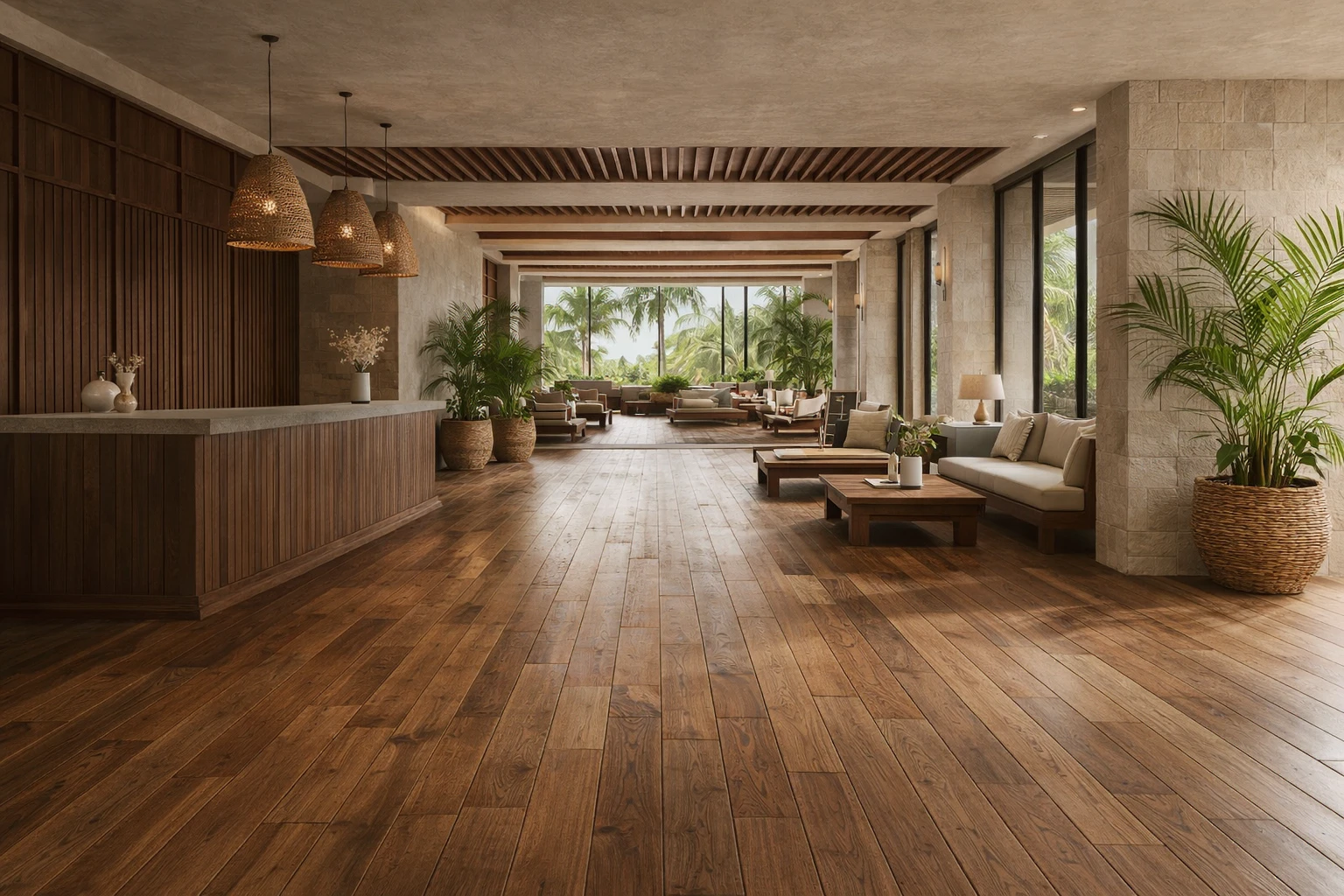
Apart from furniture and flooring, there’s a long list of timber elements that contribute to how a place actually performs, and not just how it’s splashed all over social media.
Think doors, window frames, staircases, handrails, built-in cabinetry and wall cladding.
If your occupancy is high, then these are the parts of a building and rooms that are touched every day. Opened, closed, slammed, leaned on, worn down. Yet they’re almost always ignored when resorts start talking about sustainability.
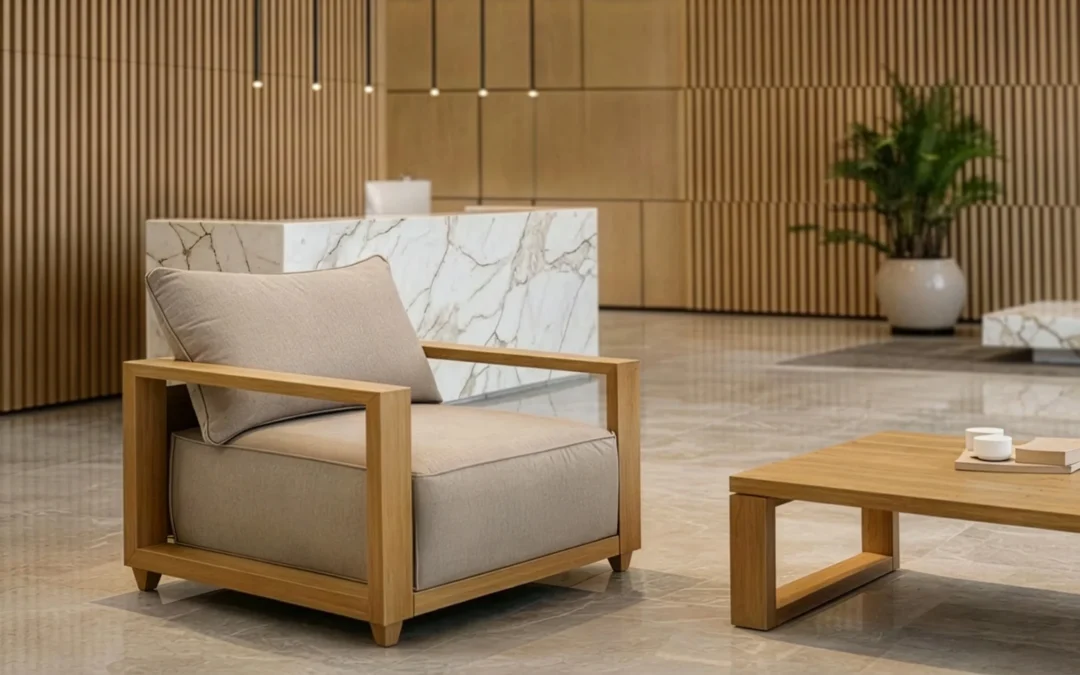
You might think that using reclaimed timber here is just a design flourish. But it’s the opposite: older, reclaimed wood simply outlasts newer, cheaper stuff, so it doesn’t just look better, it looks better for a hell of a lot longer. Factory-produced finishing elements are cheaper upfront, but over time, you know which material comes out better in the end.
Start with the Tricky Questions
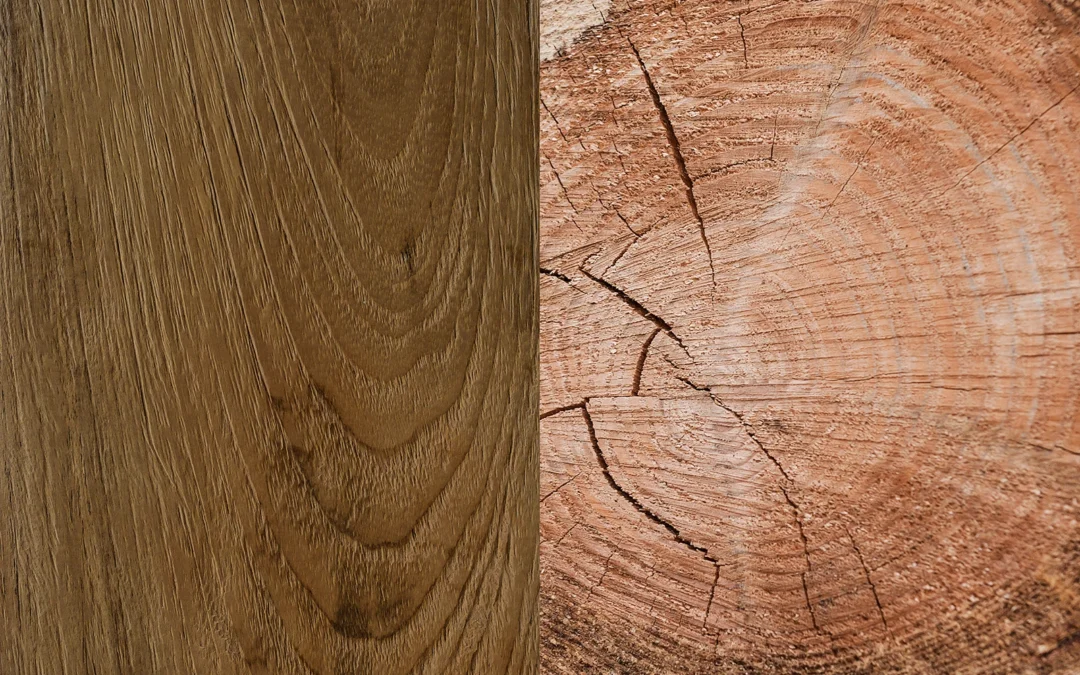
Genuine sustainability means asking uncomfortable questions. Where did this material come from? If it’s cement, what damage did its extraction and processing cause? If it’s wood, what kind of environments did it replace, and how much energy did it take to process? How long will it last? And what happens when it starts to chip and crack?
Genuine sustainability also means accepting that doing things properly is often slower, as more planning is required. Reclaimed timber isn’t the easy option. Custom furniture and flooring needs a lot more thought.
But if you’re not willing to ask these tricky questions, and not willing to take responsibility for the answers, then the eco label is meaningless.
Always Begin With “Where Does it Come From?”
If you’re planning an eco resort or environmentally friendly property, start by looking closely at your material choices. In whatever form it’s going to take, ask where your timber comes from and how long it’s designed to last.
If you want to explore custom furniture or how to incorporate reclaimed timber into your sustainability planning, we’re always happy to talk.